Engineering case study
Mindy
Turning child–character conversation into useful parent-facing reports.
- Year
- 2025
- My role
- PM · Flutter full-stack development
The problem
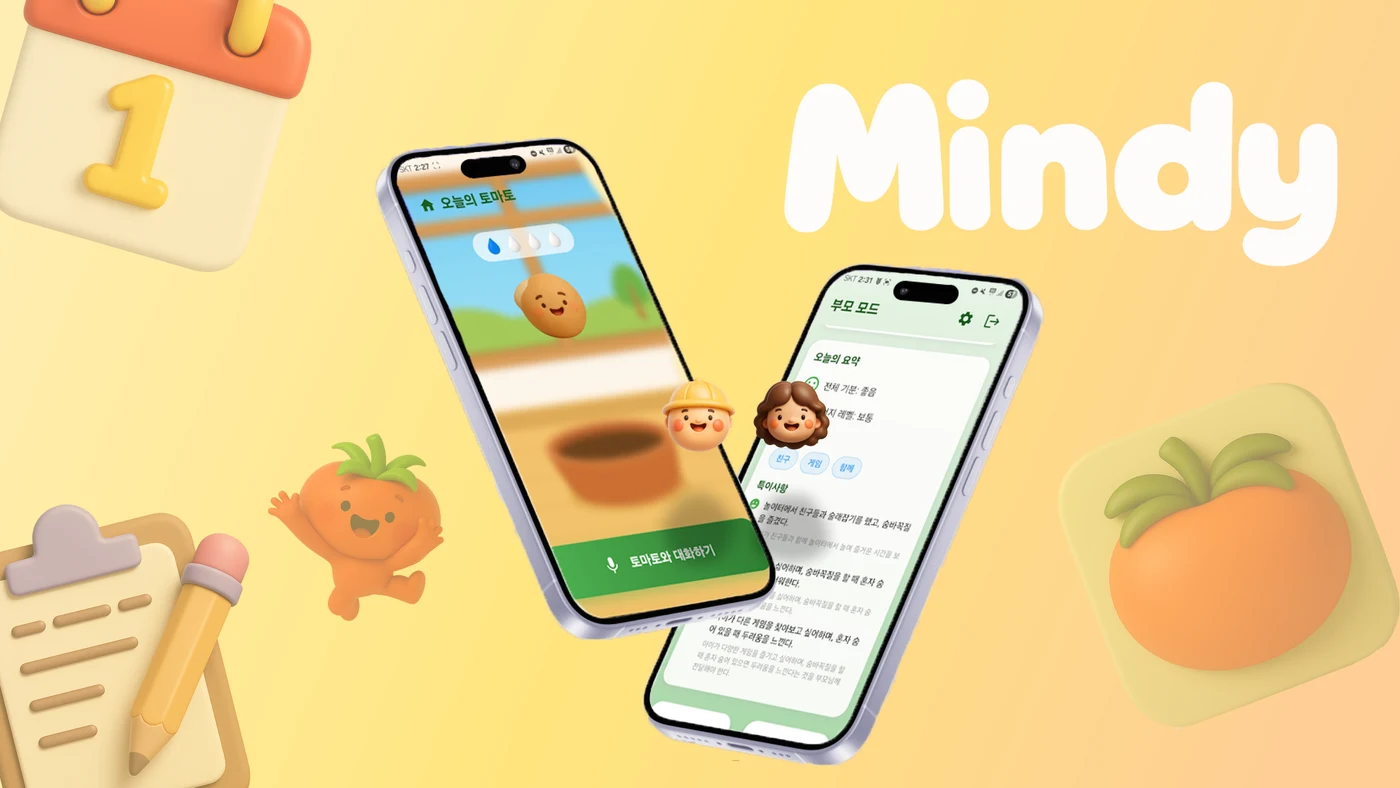
Mindy is an MVP for emotional communication between children and parents. Children talk with a character, Toma; parents see summaries and mood patterns. These two audiences need different interfaces to the same conversation.
My contribution
In a four-person team, I worked as PM, planner, and full-stack Flutter developer. My work spanned parent interviews, surveys, competitor research, personas, wireframes, and application development. The project used Flutter, a GPT API, Firebase, and Figma.
Helping children express context
Children's speech was often short, playful, or dependent on context. Treating each utterance as a self-contained statement made emotional interpretation difficult.
I designed guided prompts within Toma's dialogue to invite clearer emotional expression naturally. The interaction needed to feel like a conversation with a character, without making the child feel tested. This made conversation design part of the input pipeline rather than an addition after analysis.
Making the output useful for parents
An emotion label alone does not tell a parent what to say next. I added a generated summary layer that translated the analysis into plain-language insight and suggested conversation starters.
The resulting product separated child mode—voice conversation and the character's growth loop—from parent mode, which included reports, keywords, and a calendar-based view of mood patterns.
Outcome and takeaway
The team built an MVP joining these two experiences.
The lesson is to design the conversation and its downstream use together. Better input comes from an appropriate interaction, while a useful output must help the reader take an understandable next step. Connecting an LLM API was only one part of that design.